The client
MeraKisan is an Indian agro-export brand with two product lines: Phool Makhana (fox nuts) and quinoa. The brand supplies both D2C channels (Amazon, Flipkart) and international B2B buyers — primarily in the UAE and Vietnam.
When the engagement started in December 2025, the site had minimal organic footprint. There was product. There were FSSAI certifications. There was a working supply chain. What was missing was discoverability — on Google, by the buyers who were already searching for exactly these products.
The problem
Agro-export is a fragmented, trust-driven market. B2B buyers in the UAE search for "makhana bulk supplier India" or "quinoa exporter India". They get flooded with directory listings — IndiaMART, TradeIndia, ExportersIndia — and generic exporter profiles. Few actual exporter websites rank. Fewer still look like serious businesses.
The brand needed to own its own search real estate: country-specific landing pages for the UAE, SEO-optimized product and category pages that could rank for buyer queries, and the kind of visible compliance signals (FSSAI, certifications) that make an international buyer take a first meeting.
What we did
1. Full site rebuild with export buyer intent
Rebuilt the homepage and core pages as a self-contained HTML build structured around B2B export signals — not D2C aesthetics. Brand system locked (greens #005A4D / #003D34, gold #C09A35, Roboto typography) so every page reinforced the same identity.
2. 15-tab SEO workbook — strategy before execution
Keyword research, buyer-query mapping, competitor gap analysis, content calendar, technical SEO checklist, and country-specific SERP review — all tracked in one workbook. SEO on an export site needs discipline: the queries that convert ("bulk supplier", "FOB price", "container MOQ") are different from the queries that only drive traffic.
3. UAE country landing page
A dedicated page targeting UAE B2B buyers specifically — Dubai, Abu Dhabi, Sharjah — with country-relevant trust signals, shipping terms, and a WhatsApp CTA tuned for Gulf buyer behavior. One of the first ranked assets outside the core product pages.
4. Meta Ads blueprint for UAE WhatsApp leads
A full Meta Ads playbook running in parallel with SEO — targeting UAE B2B buyers through WhatsApp lead flow. SEO + paid combined so the two channels compound: paid tests what buyers respond to, SEO captures the queries once they're known.
5. Vietnam buyer outreach — 14 enriched contacts
For the Vietnam market, a direct outreach spreadsheet with 14 researched quinoa buyers — company, decision-maker, contact details, buying signals. Direct outreach layered on top of inbound SEO: the two work differently, and together they cover both buyers who search and buyers who need to be approached.
Results
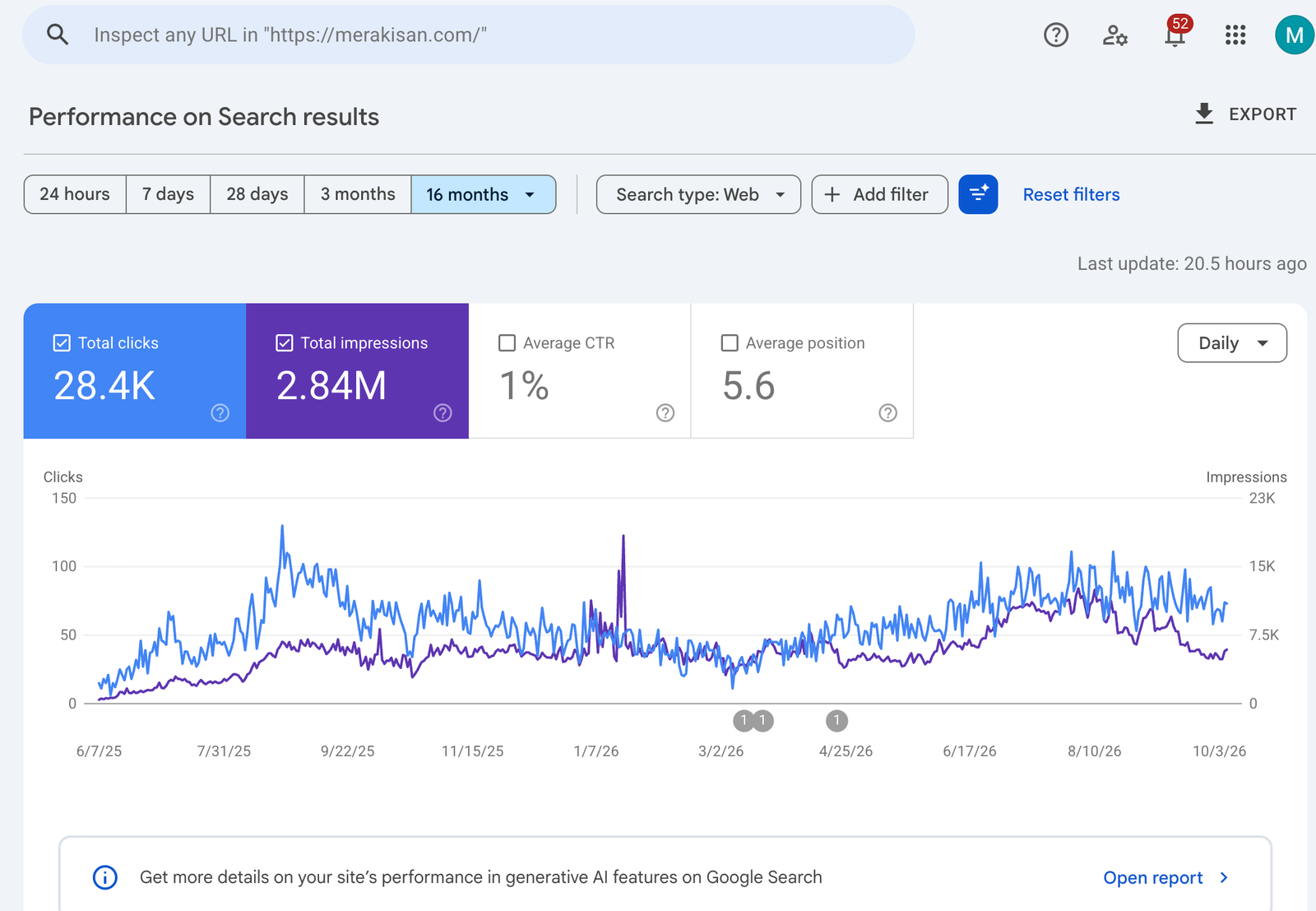
2.84M organic search impressions in 16 months
From near-zero visibility to a sustained impression curve. The screenshot above shows the trajectory: slow climb through mid-2025, consolidation into a stable baseline, then a new high through mid-2026 as more product and category pages matured in search.
28.4K organic clicks
Over the same window. These are the clicks that landed on the actual site — not directory listings, not aggregator pages. B2B buyers reading the brand's own content, product specs, and compliance information.
Average Google position: 5.6
Across all ranked queries. Position 5.6 average means the brand consistently appears on page one of Google for the queries it ranks on — the queries where buyer attention actually exists. This is the number that separates "indexed" from "visible".
What this proves
- → Indian agro-export brands can rank in international B2B search — the directory sites dominating these queries aren't invincible, they're just rarely challenged.
- → Country landing pages work when they're built around how that country's buyers actually search and buy — not when they're generic templates with the country name swapped in.
- → SEO + paid + direct outreach is the right export mix. One alone leaves gaps; three in parallel compound because they cover different stages of buyer discovery.
- → FSSAI and compliance signals aren't a legal checkbox — they're conversion assets. Make them visible on every page an international buyer could land on.
Honest note: The metrics above are organic search performance — top-of-funnel. Business outcome tracking (B2B inquiry → sample order → container order) runs separately in the brand's CRM. This case study documents the SEO execution and visibility result. Buyer-pipeline attribution for the same window is available on request under NDA.
Export brand that needs organic visibility in overseas markets?
If you're exporting from India and losing visibility to directory sites, this is the playbook. Let's talk through your target markets and product category.
Discuss on WhatsApp →